
SIMbae™ Honored for IoT Innovation
Raleigh, NC—March 9, 2026 —
Today’s enterprises and public-sector organizations are deploying a myriad of mobile devices across complex combinations of public cellular, private 4G/5G, Wi-Fi, satellite and other networks. To manage and control a diverse fleet of mobile and IoT devices and guarantee the behavior across network boundaries and operational context can be a complex task. New capabilities within the SIM/eSIM applet environment are now available without relying on operating systems, applications, cloud-based intelligence, or user intervention. Welcome to the world of context-aware network orchestration at the identity layer.
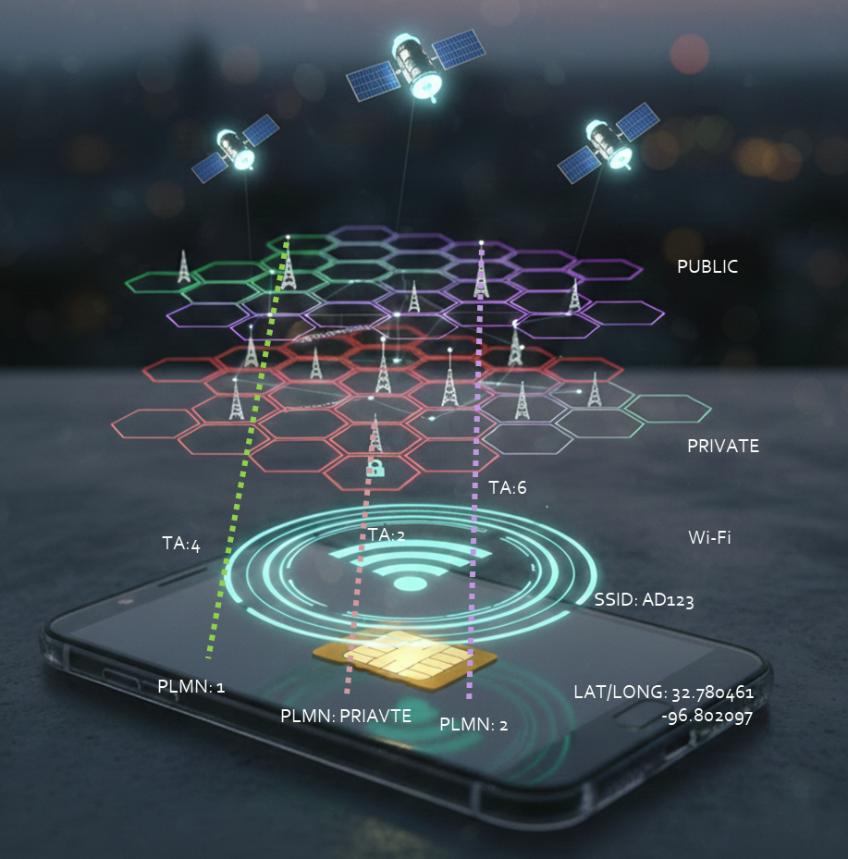
Advancements in SIM/eSIM applet development are enabling applets to gain access to contextual information that can aid in more sophisticated decision making and control of network connections directly at the device/SIM level under control of the enterprise. At the leading edge of this capability is context-aware connectivity orchestration inside the SIM/eSIM secure element. Able Device’s SIMbae applet has been enhanced to include multi-source contextual awareness, including:
- Satellite positioning systems (e.g. GPS/GNSS lat/long)
- Wi-Fi environment signals (e.g. SSID)
- Cellular radio proximity metrics (e.g. Timing advance)
- Real-time network rejection intelligence (e.g. MCC, MNC, LAC/RAC/TAC and precise cause)
Access to operating context information allows the SIM/eSIM applet to build a more sophisticated situational awareness enabling advanced decision making on device operational cases including
- Controlled transition between public and private networks
- Dynamic management of subscription identities (IMSI) in real-time
- Enforce secure network attachment policies based on context
- Generate secure alerts or reporting based on device situational context
- Improve roaming QoS, optimize network selection, and enforce deterministic cellular behavior across heterogeneous fleets and hybrid environments.
With the latest SIMbae release, the expanded device context information is easily incorporated into SIM applet logic executed inside the SIM/eSIM which is easily customized by utilizing its low-code/no-code configuration environment. All of this is included in the standard SIM applet deployment models that are managed over-the-air, independent of device OS and invisible to end users.
Additionally, SIMbae supports deterministic network switching in real mobility scenarios across heterogeneous fleets — including NTN satellite fallback and private network switching based on context — with validation of cellular signal strength and data connectivity availability and automatic reversion if QoE criteria are not met.
A shift from dependence on external device management from the user, cloud, or proprietary app to SIM secured embedded, deterministic control reduces operational risk, lowers total cost of ownership, and enables organizations to scale private, public, and hybrid connectivity strategies with confidence.
Example 1: Private Network Adjacency Detection and Control
A vehicle operating near a private 4G/5G deployment may initially attach to a public macro cell adjacent to private coverage. SIMbae can be configured to automatically detect adjacent network conditions and proactively search for the private network. Upon detection and validation, it forces the transition into the private cellular network. QoE thresholds can be implemented to ensure that private coverage meet configured standards, otherwise the device stays on the public macro network until conditions change. This provides enterprises and private network operators with seamless control in and out of private networks.
Geofencing add-on: With access to GPS/GNSS coordinates, the connection management applet can also implement a geofence control that can manage access to the private
cellular network within a defined physical boundary, strengthening security and boundary control.
Example 2: Wi-Fi Triggered Private Attachment
A mobile device connected to a known enterprise SSID co-located with private cellular infrastructure can initiate private network attachment automatically. In a large Manufacturing facility a secure local private cellular network may be available on the manufacturing floor with a broad enterprise Wi-Fi network. A mobile device can be configured to detect the private cellular network and attach to access secure manufacturing platform on the floor without manual intervention by the end user. This bridges Wi-Fi context with cellular policy at the SIM layer.
It’s time to rethink modern SIM/eSIM applet use cases and how they can solve complex diverse device based challenges with new streamlined development capabilities. A common SIM/eSIM applet strategy can play a key role in controlling how devices operate in the context of today’s multi-network operating environment.