
By Bob Gessel
In a previous post, I explored how the latest generation of Java Card SIM applets can deliver new levels of scalability, security, serviceability, cost efficiency, and resilience across mobile and IoT devices. Now, let’s look at how organizations can fully unlock that potential—faster and more efficiently than ever.
Reduce Development Time and Cost with Modern SIM Applet Platforms
Traditionally, creating SIM applets requires specialized Java Card developers working on one-off coding projects. While effective, this approach can be slow, costly, and difficult to scale. Today, modern SIM applet development platforms like Able Device’s SIMbae – SIM based Application Engine- change the game. By using pre-built, configurable building blocks and orchestration tools, teams can create sophisticated, multi-functional SIM applets in a fraction of the time without deep Java Card expertise. These modern platforms enable new applet capabilities including:
- Combine multiple SIM functions into coordinated, intelligent applets that interact and build on each other.
- Enhance device, connectivity, and applet management through automated debugging, restarting, and remote maintenance.
- Rapidly build and evolve functionality using no-code and low-code
These enhanced capabilities empower teams at MNOs, Service Providers, Integrators, and enterprises to accelerate SIM applet innovation with more advanced SIM behavior turning the SIM from a basic connectivity component into a strategic, programmable asset.
Keeping Pace with eUICC Evolution
The ongoing evolution of eUICC standards continues to unlock new functionality for enterprise mobile, IoT, and M2M devices. Each release creates opportunities for platform and service providers to deliver smarter, more capable applications tailored to the unique needs of the use case. As the capabilities become more sophisticated, the benefits of working with applet development platforms enables development teams to immediately take advantage of standards evolution using ready-made frameworks for critical SIM functions such as:
- Local network selection
- Connectivity optimization
- Security and policy enforcement
- On-device automation independent of the host OS or cloud
- Device monitoring, debugging, and control
Maximizing Development Resources – Simplifying Scale, Reducing Complexity
As SIM environments grow, so does the challenge of managing multiple custom applets. The concept of combining SIM applet functions into a consolidated “super-applet” consisting of organized, modular units that automatically manage internal interactions and dependencies has traditionally been challenging. However, this concept can reduce the cost and complexity of development, upgrades, and support, while enabling faster prototyping, testing, and deployment cycles. This is where SIMbae brings unique platform capabilities that enable rapid, sophisticated development for the super-applet concept.
Device Management and Remote SIM Management platforms that incorporate applet development and deployment incur development costs with traditional coding approaches dependent on highly specialized Java Card software development resources. By moving from traditional coding to a platform-based approach, teams can cut development time and cost dramatically—often achieving up to 5x faster delivery. No-code and low-code features make it possible for a broader range of developers to contribute to SIM applet innovation, shortening development cycles from months to weeks. SIMbae’s pre-built, field-tested building blocks continue to evolve through real-world deployments, giving teams the reliability of proven modules with the flexibility to innovate on top.
Go Beyond Basic Connectivity Control
Most SIMs today still manage only basic connectivity control. With SIM applet development platforms, organizations can finally unlock the untapped potential within the SIM by enabling intelligent connectivity management, device control, and even new revenue-generating service opportunities. Enterprises and managed service providers no longer need to rely solely on vendor-supplied, fixed applets. With solutions like SIMbae, they can build, customize, and optimize their own SIM-based capabilities with “out-of-the-box”, proven, tested capabilities to deliver smarter, value-added services.
The Value of SIM Based Device Monitoring, Management and Control
Device monitoring, management and control via SIM applets may not go as deep as is possible today due to complexity to develop. SIMbae brings many features and functions related to remote diagnostics that enable valuable capabilities such as:
- Remote reboot of a device
- Reset a wireless connection
- Monitor and query the SIM’s status
- Monitor and trace communications stack issues remotely, in real time.

These capabilities can speed up time to resolution through remote troubleshooting and replace expensive truck rolls and on-site device maintenance to physically engage in device connectivity and operations troubleshooting and resolution.
|
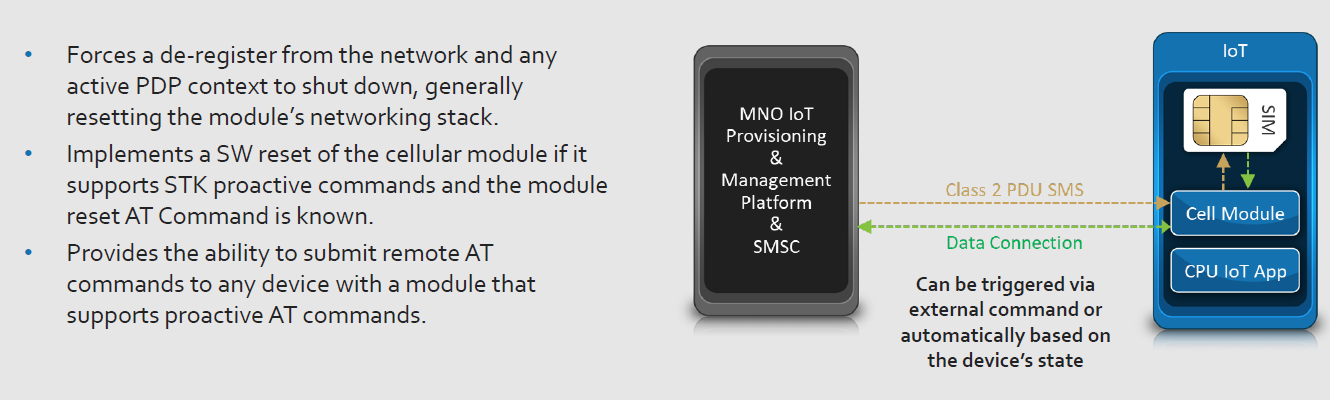
EXAMPLE: Diagnosing and Managing Unresponsive Devices Customers and service providers are often unable to communicate and diagnose issues when IoT devices are unresponsive in the field. Devices are down longer than what is acceptable due to challenges with physical access to the devices in order resolve issues. Sending technicians onsite to diagnose and fix is very expensive and inefficient. SIMbae™ software applet provides a parallel path alongside existing device app management to diagnose issues. It can execute actions via external command or automated based on the state of the device to either reset, restore and/or ensure other corrective actions are taken. Standard tools and diagnostics with OTA installation and upgrades provide customers seamless device management despite lack of standardized IoT device architecture across the environment. IoT Devices also are often sent into the field without all the necessary features to diagnose issues in the field. A SIMbae generated applet can utilize the cellular module and AT commands to assist with diagnosing field issues alongside the device’s main firmware.
In addition, a device could be very hard to reach and requires a remote hard reset. SIMbae applets integrated with a cellular module that has been integrated into a HW switch in the device PCB can enable remote HW reset. Below is an example of how such and integration can enable remote resets.
|

Conclusion
Modern SIM applet development is transforming how mobile and IoT devices are managed, with platforms like Able Device’s SIMbae enabling organizations to move beyond traditional, time-consuming Java Card coding toward a faster, more scalable, and cost-efficient approach. By leveraging pre-built, configurable building blocks and no-code/low-code tools, SIMbae empowers teams to create multi-functional, intelligent SIM applets that integrate network optimization, security enforcement, automation, and device control—turning the SIM into a strategic, programmable asset. As eUICC standards evolve, SIMbae helps developers and enterprise IT departments instantly capitalize on new capabilities while simplifying scale and complexity through modular “super-applets.” The result is dramatically reduced development cycles, enhanced operational efficiency, and the ability to unlock new revenue-generating services through advanced SIM-based monitoring, management, and control—eliminating costly manual interventions and accelerating innovation across connected ecosystems.
Rethink how modern SIM applet development platforms can accelerate time to market and time to revenue in your business.
To learn more, please visit our SIMbae page: https://abledevice.com/simbae/.